There is something disorienting about standing in the middle of what was, sixty years ago, a working salt farm — and hearing nothing but wind.
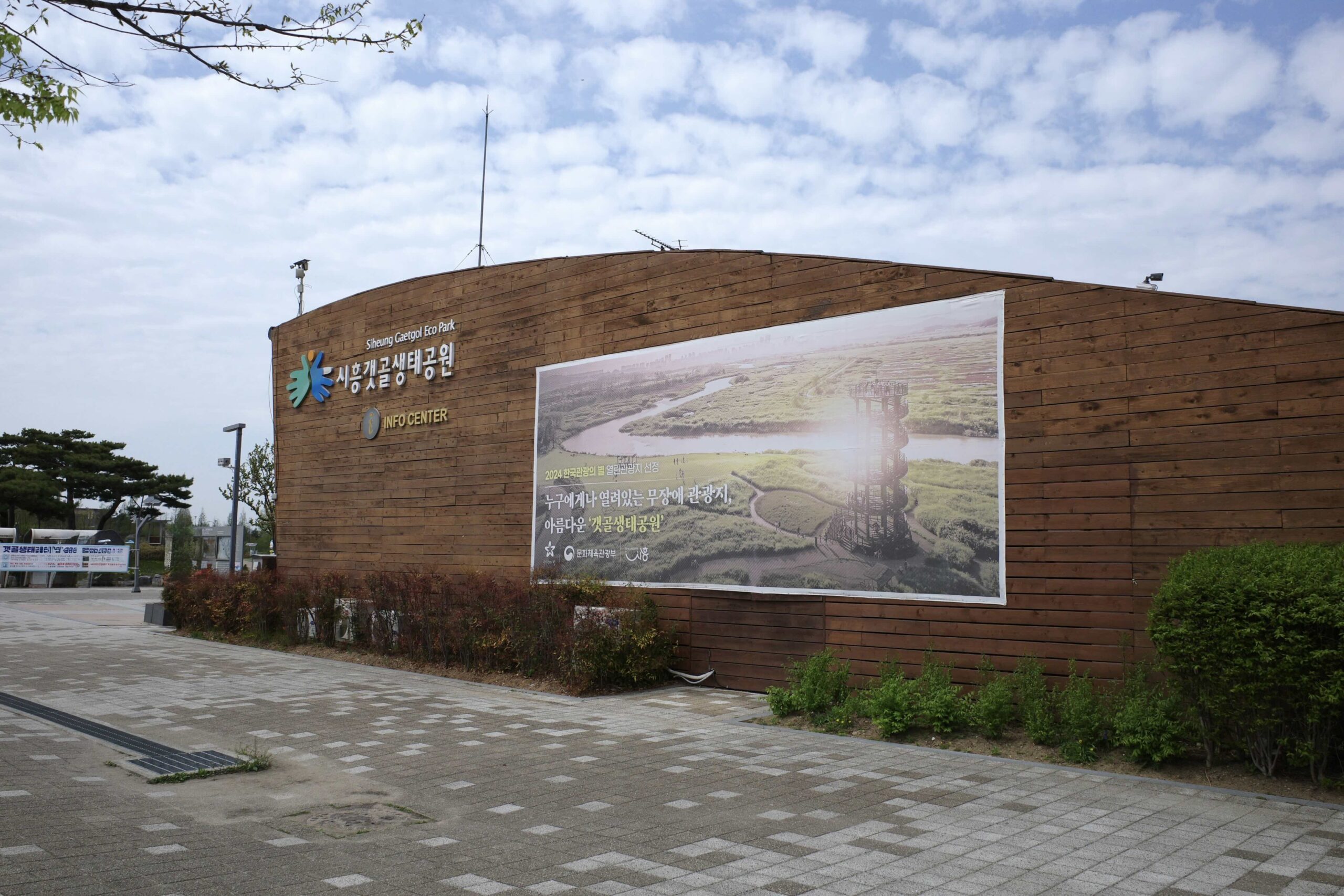
Siheung Gaetgol Eco Park doesn’t announce itself the way most destinations do. It sits in Siheung City, Gyeonggi Province, a wetland formed on a deep inland tidal flat on the site of an abandoned salt farm spanning almost five million square meters. The scale only registers slowly — first as a sense of unusual openness, then as something closer to awe. The sky here is genuinely big. The horizon is genuinely far. For anyone accustomed to Seoul’s compressed distances, Gaetgol delivers a kind of spatial shock.
A Farm That Disappeared Into the Land
Siheung Gaetgol was originally established as the Sorae Salt Farm in 1934. The Sorae Salt Farm remained in operation until July 31, 1996, at which point it had accounted for roughly 30% of South Korea’s total salt production for six decades, the livelihood of generations of families in Podong and Bangsan-dong. After closure, it sat abandoned for more than ten years before Siheung City began reclaiming the site. The conversion took nearly a decade, and what emerged was not a sanitized park but something stranger and more honest — a landscape in the process of becoming something else, the old life still visibly underneath.
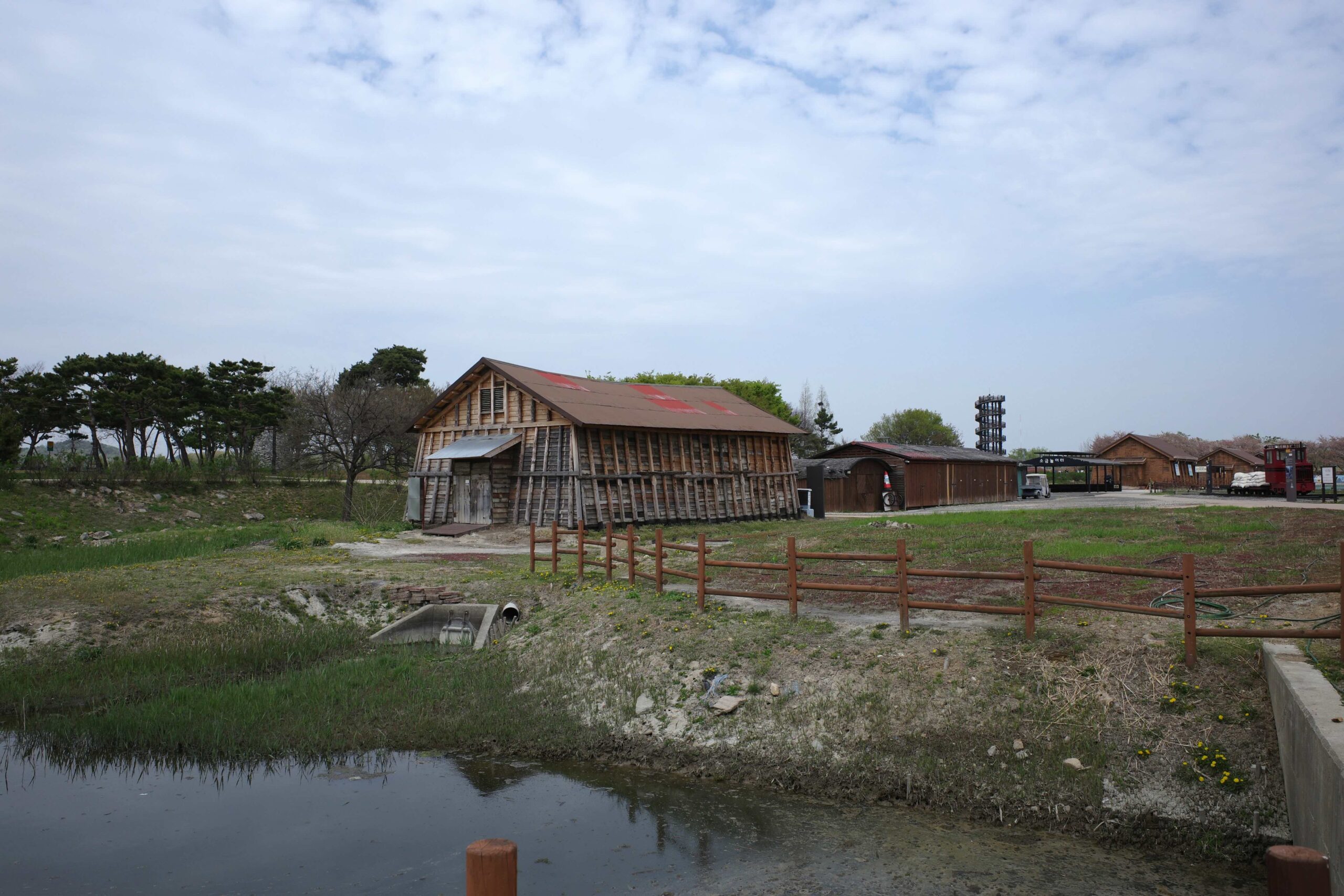
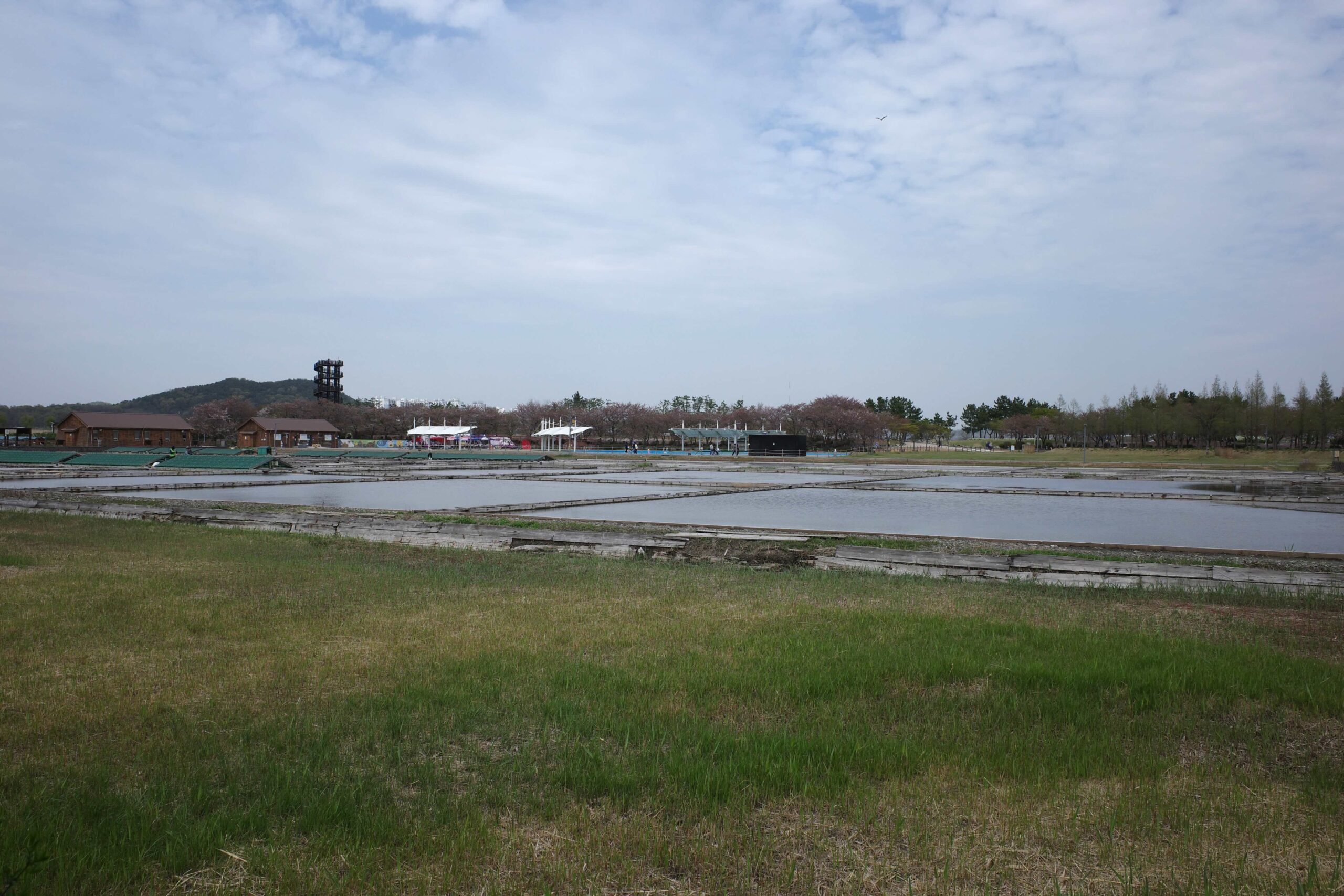
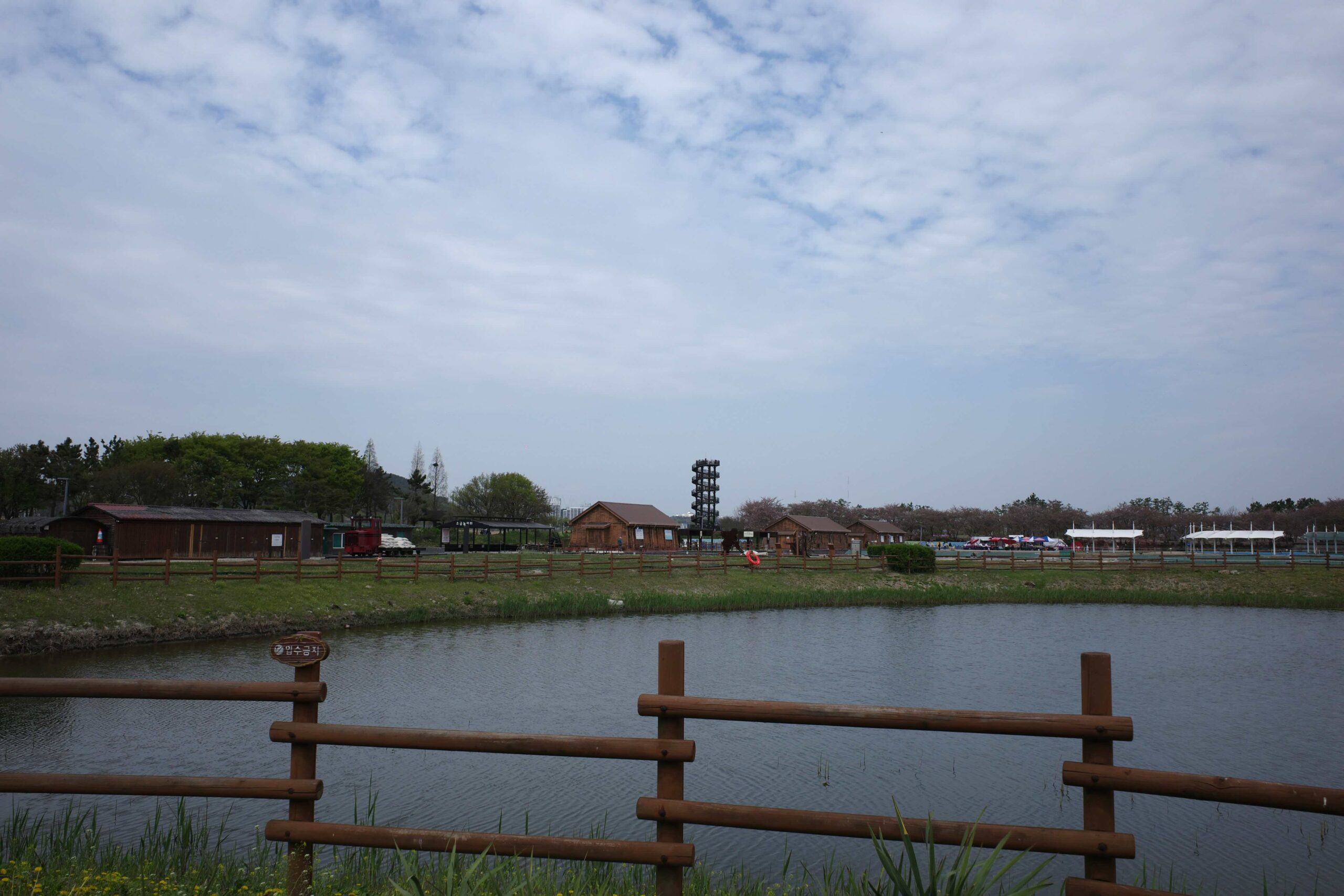
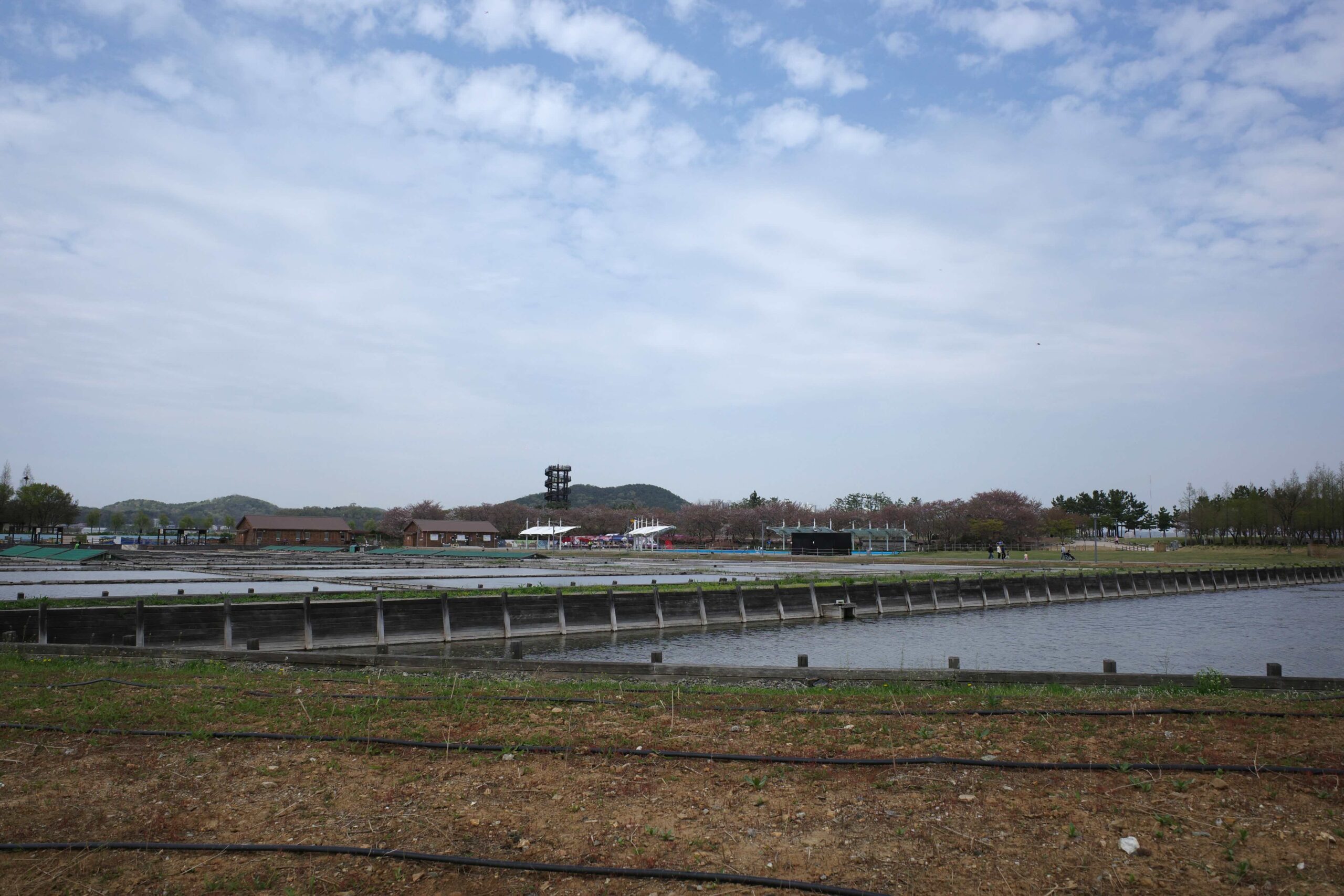
The salt farm area was formed around the tidal flat, and most of the salt produced here was transported to Busan Port by train on the Suin Line before being sent on to Japan during the colonial period. That history doesn’t shout. It sits quietly in the weathered planks of the old salt warehouse — a bare-bones timber structure, diagonal slats bleached and warped, a red cross faintly visible on the roof — and in the geometric lines of the evaporation pans, still filled with shallow water, still gridded by low concrete ridges, still reading as infrastructure even as grass grows between the cracks. The industrial and the ecological coexist without resolution, and that unresolved quality is precisely what makes the place interesting.
The Shape of the Land
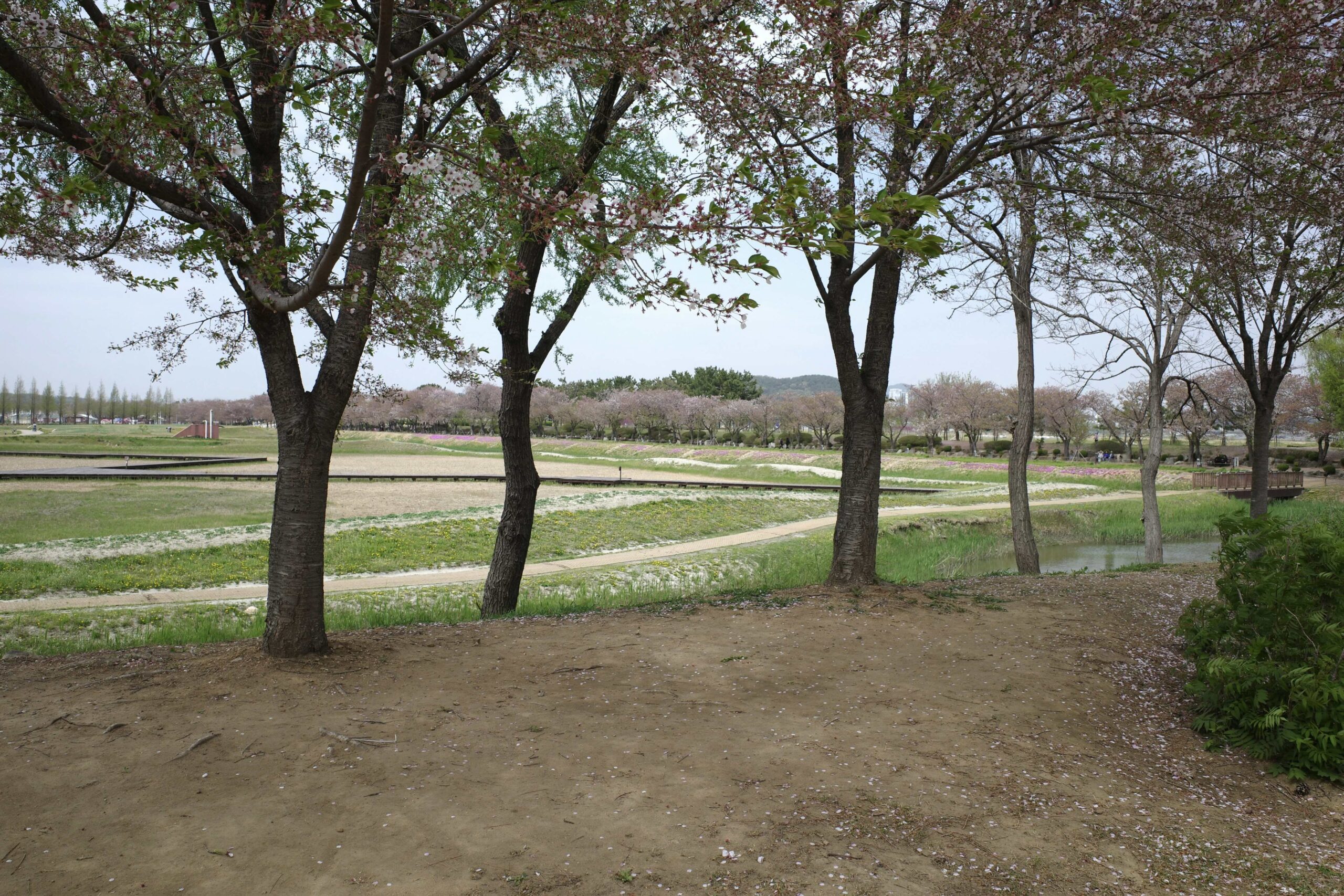
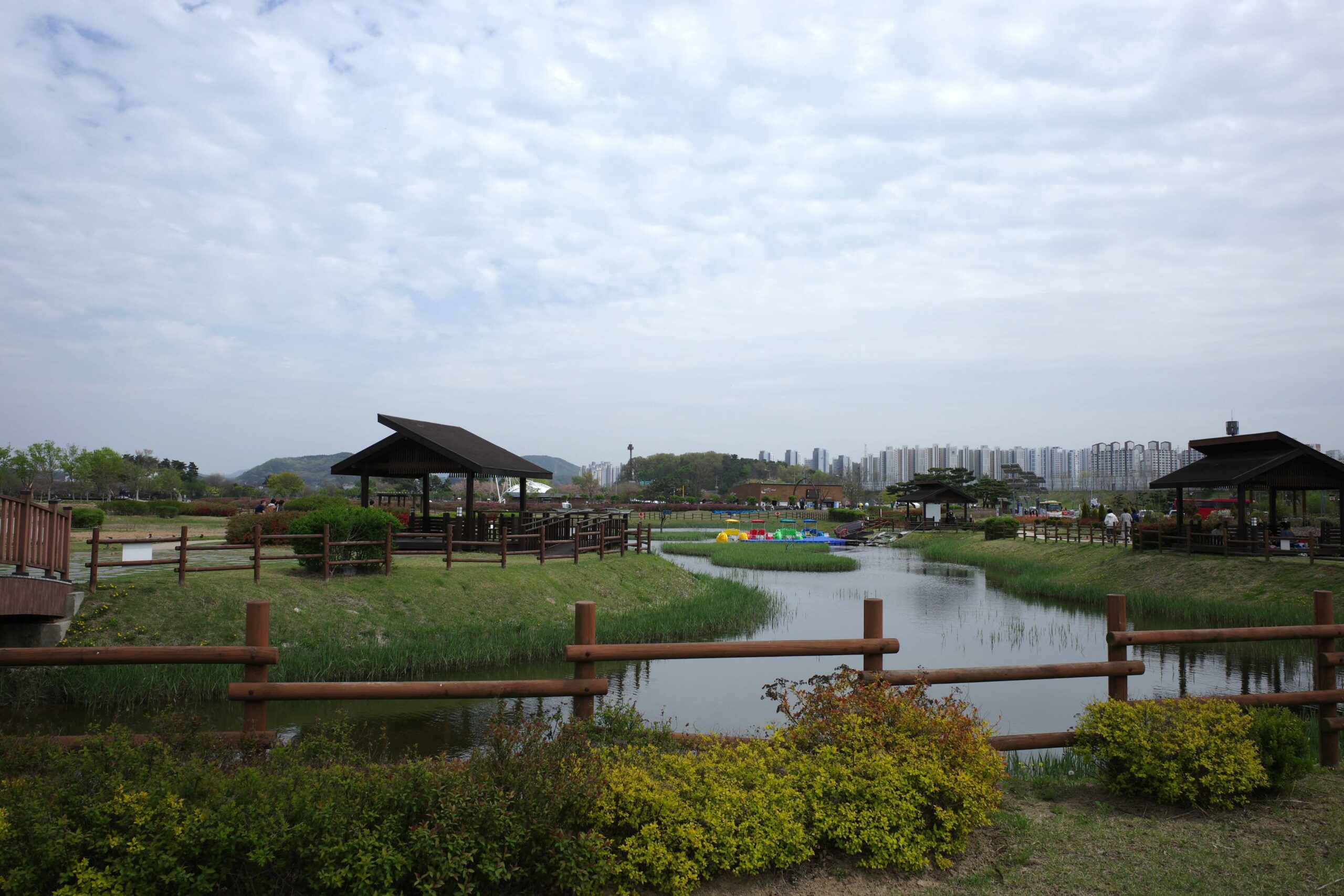
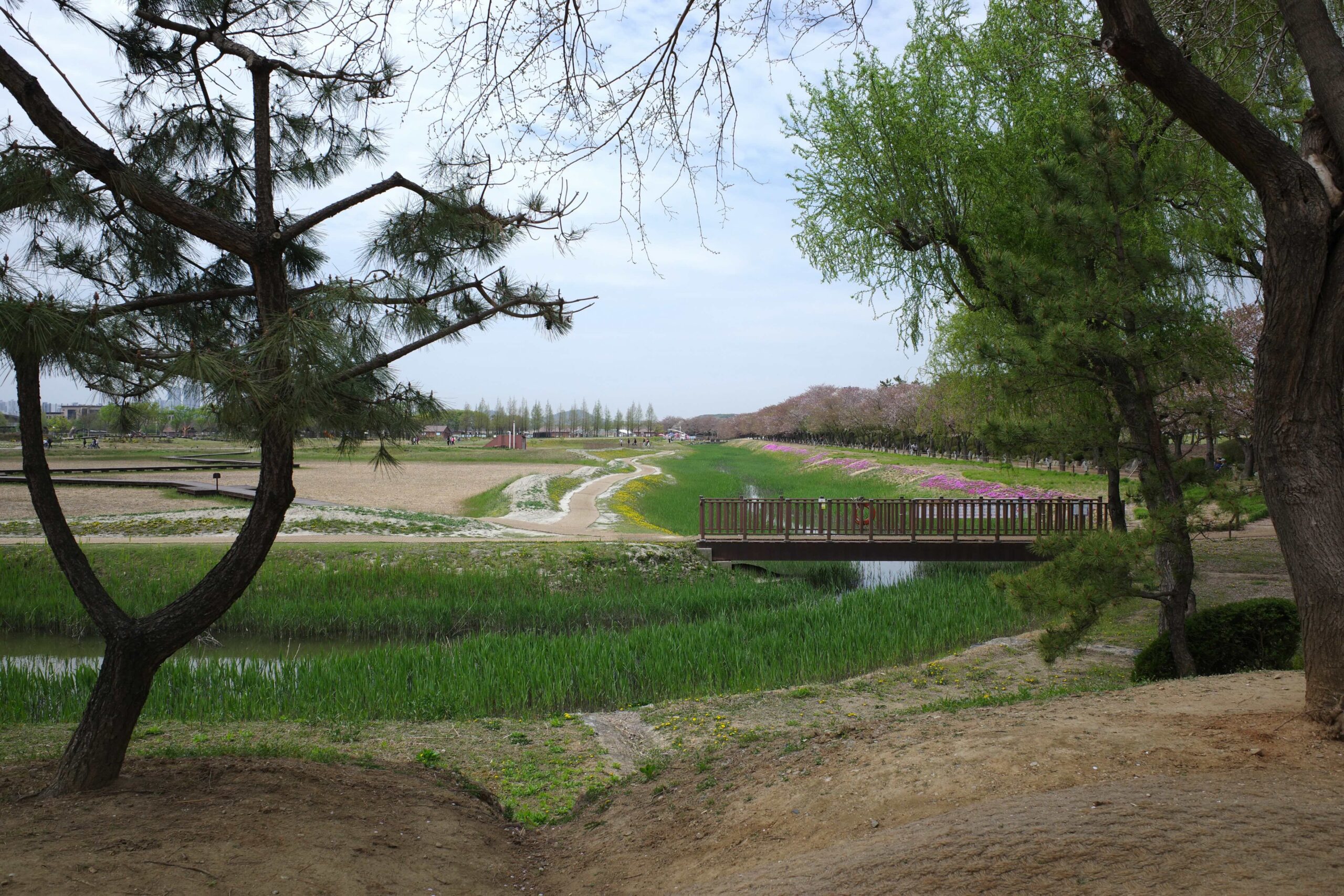
Gaetgol features the nation’s only inland tidal flat — a rare formation where seawater ebbs and flows deep into the mainland along a sinuous, meandering channel. Walking through the park, that channel reasserts itself constantly: a still ribbon of water threading through reed beds and grass, crossed by wooden footbridges, bordered by driftwood railings. Salt-tolerant plants such as glasswort, seepweed, and Suaeda japonica — as well as fiddler crabs and mudskippers — inhabit the tidal areas. The park was designated as a National Coastal Wetland Conservation Area in February 2012.
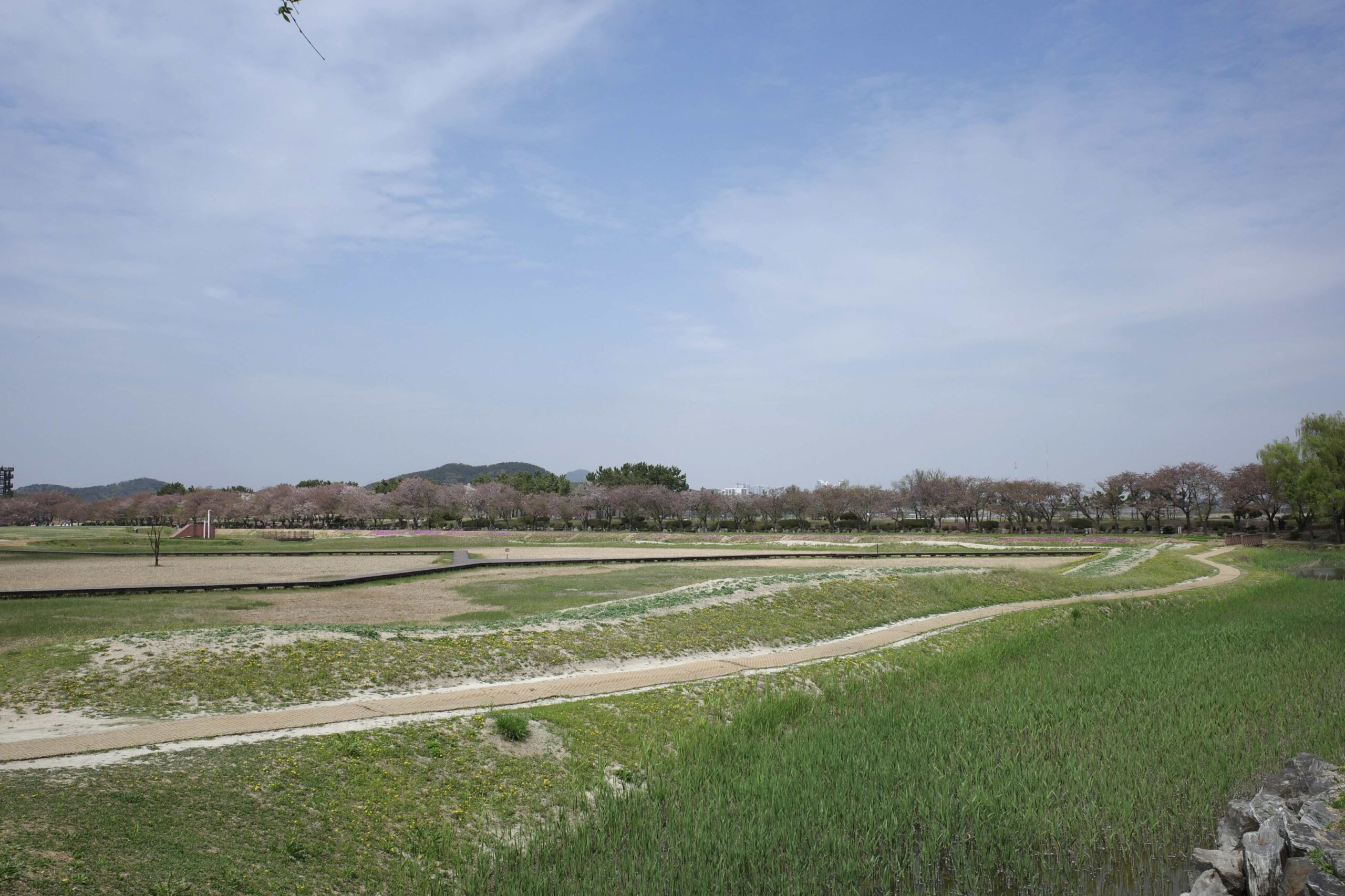
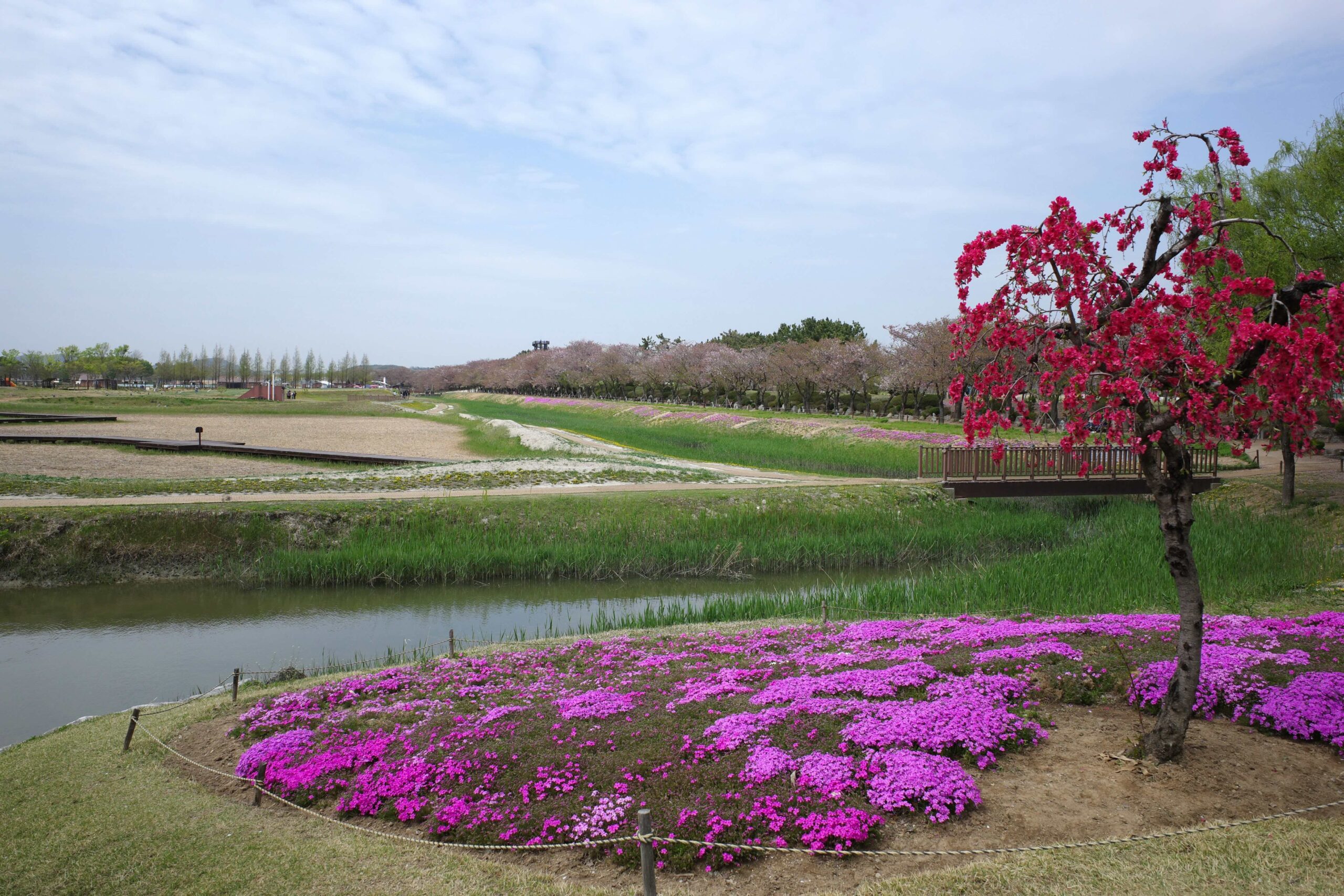
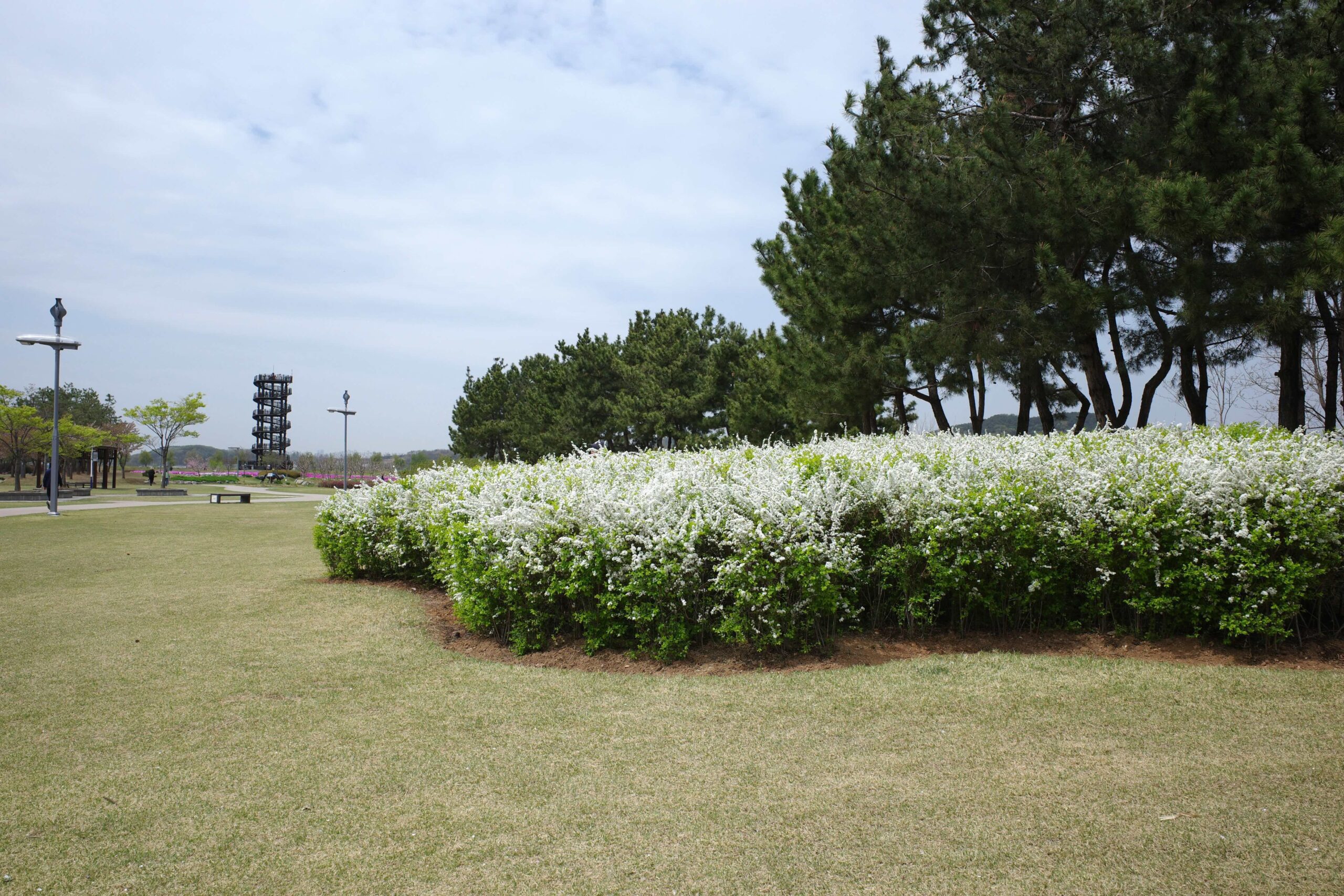
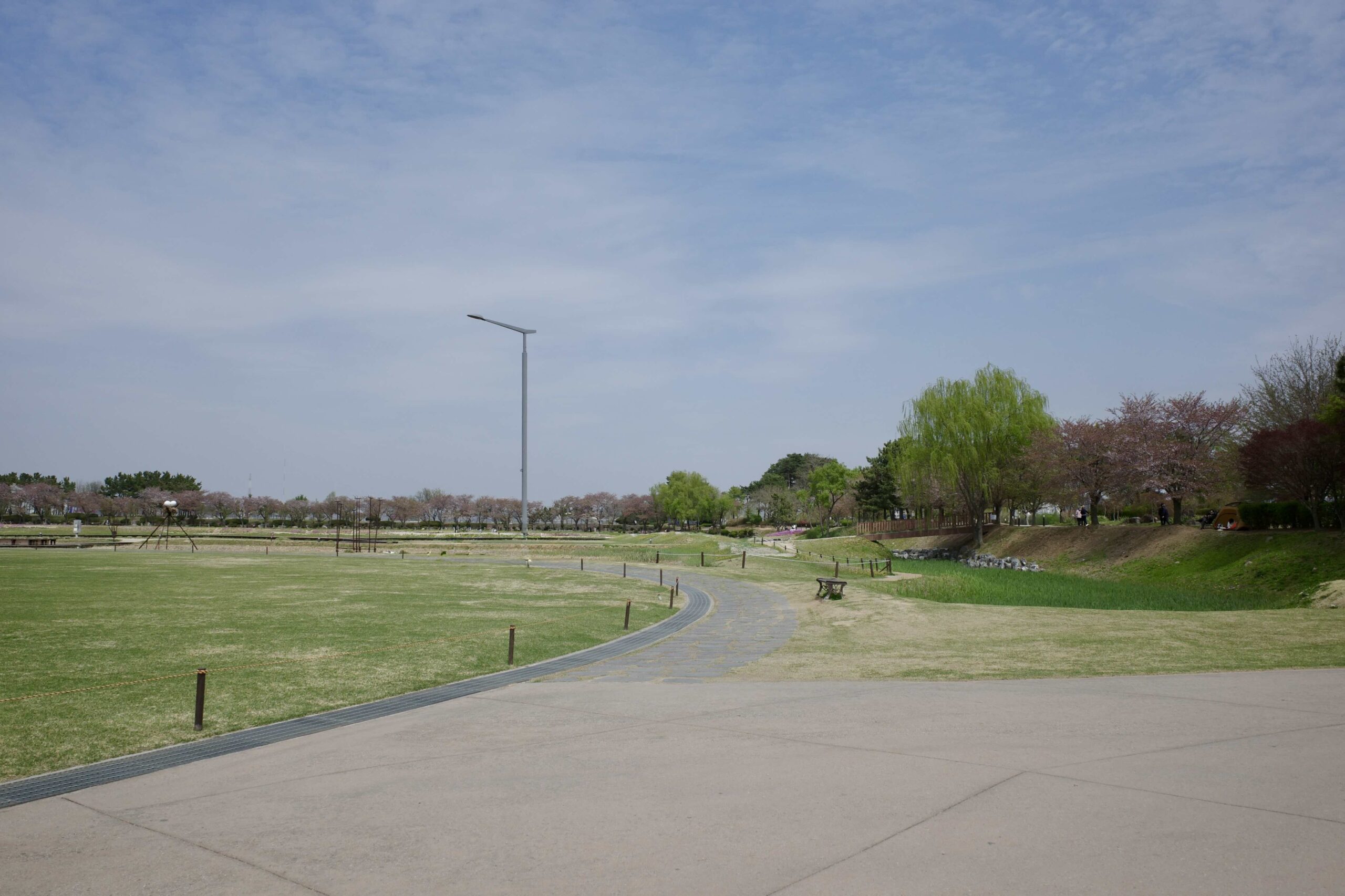
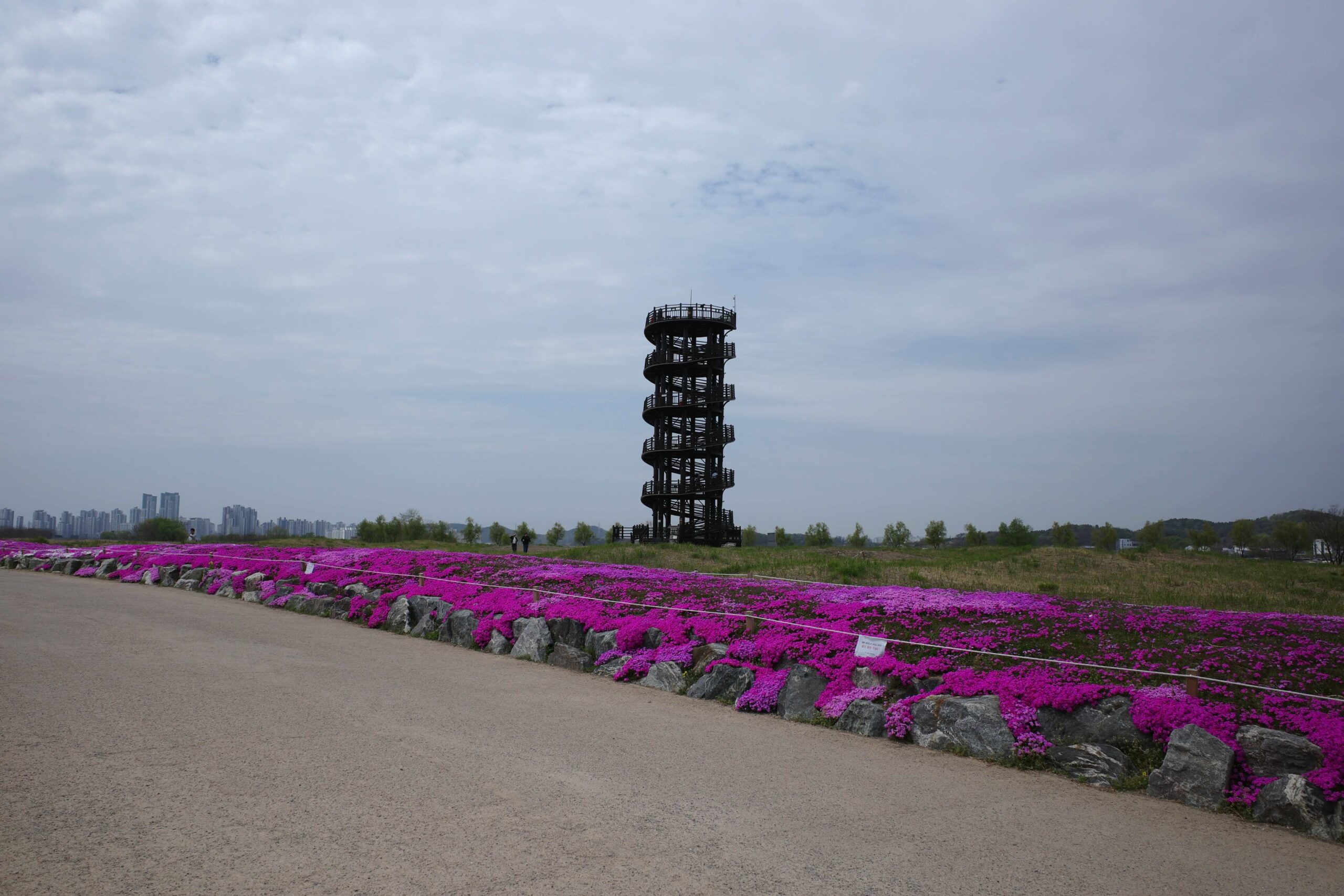
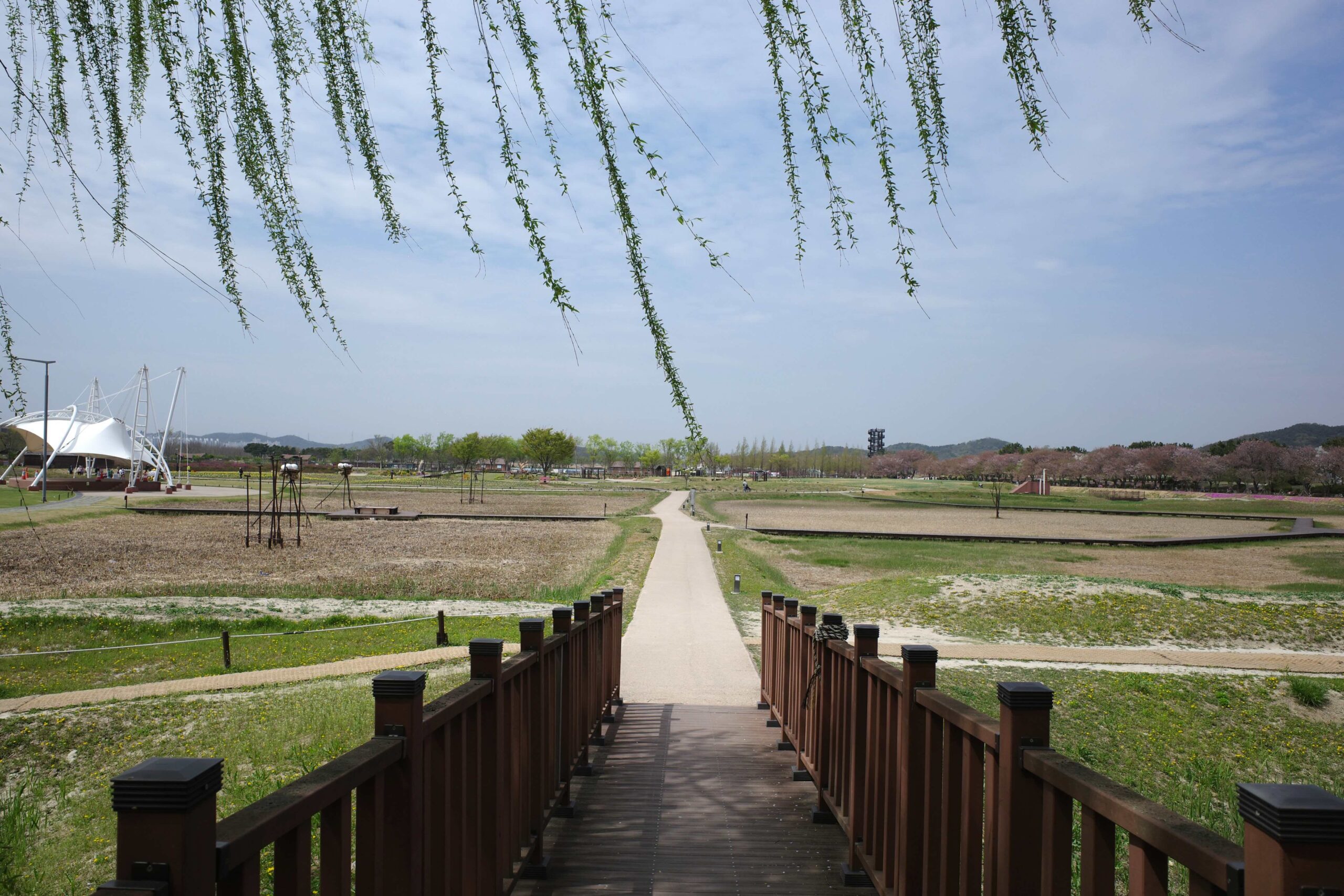
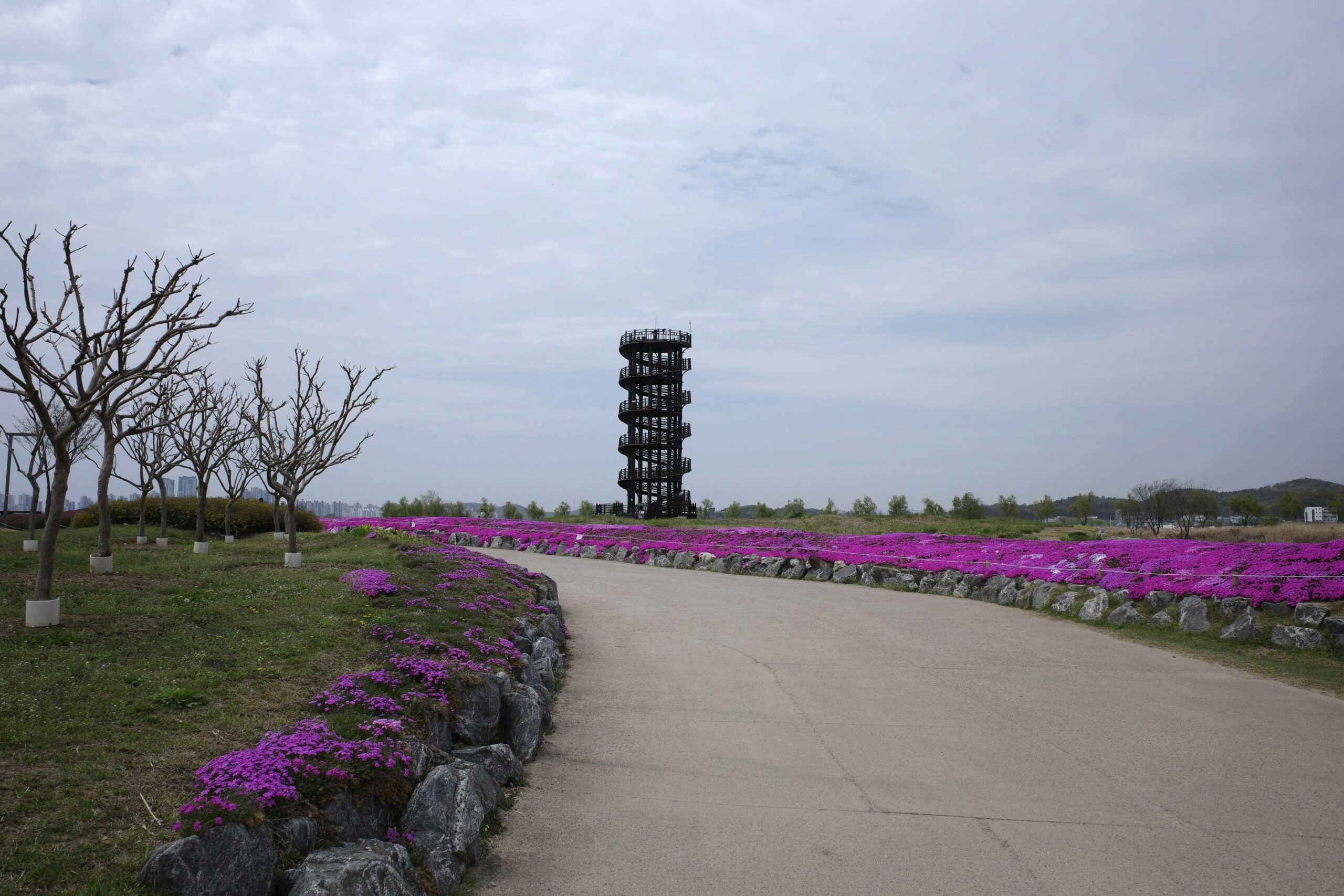
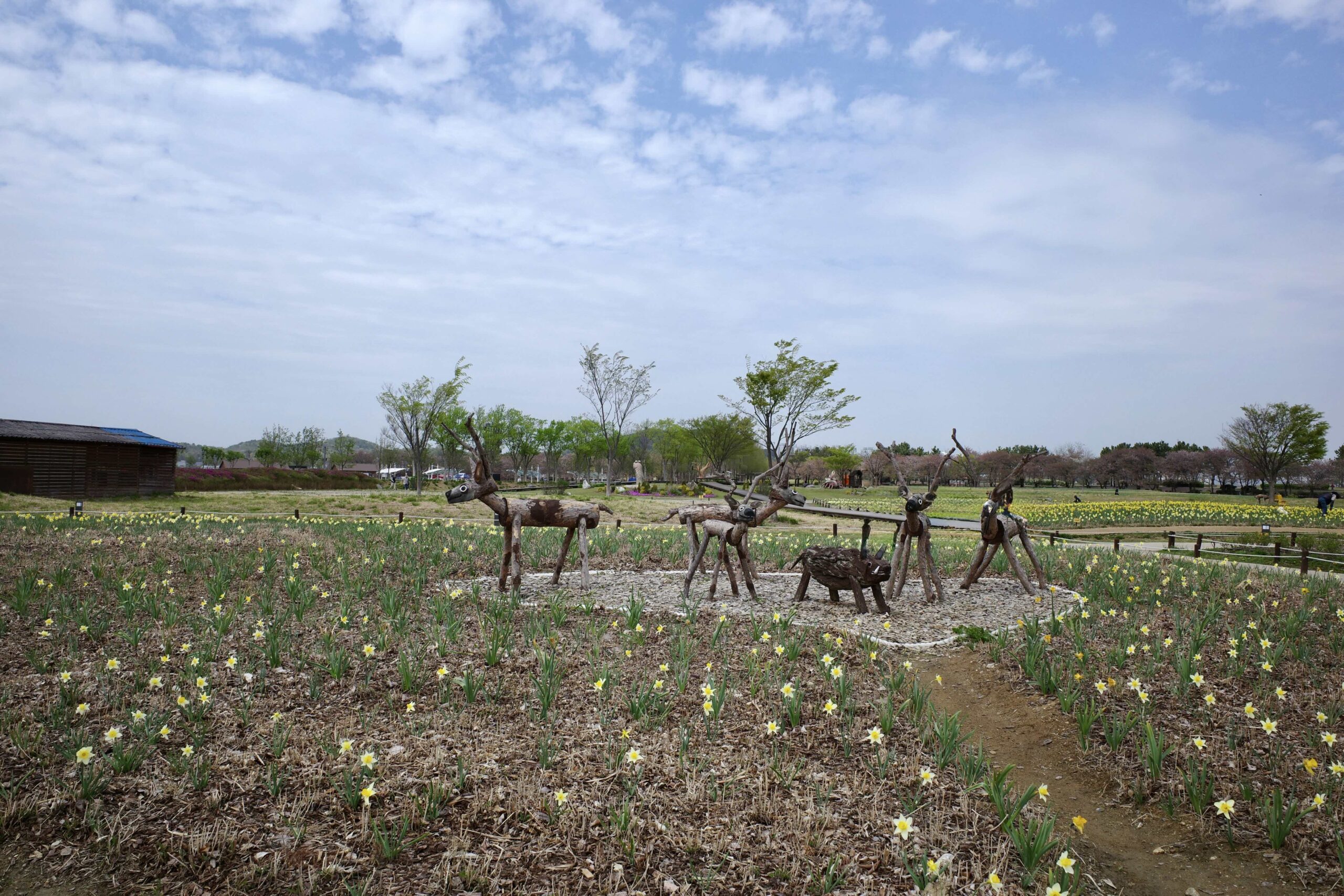
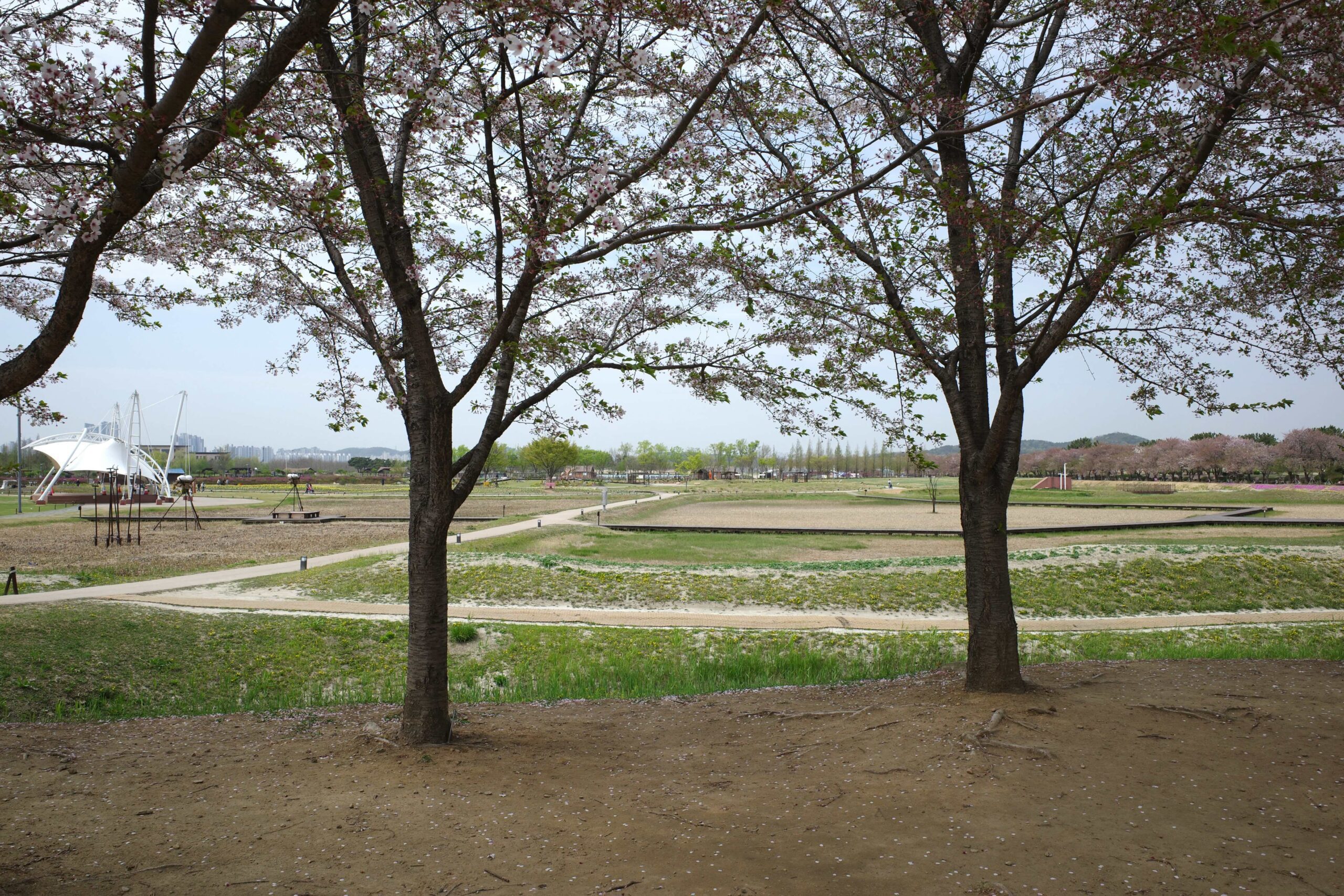
In spring, the ecological backdrop acquires color in layers. Cherry blossoms line the perimeter paths in long, loose corridors, already shedding petals by mid-April, pink confetti pressed into the bare soil underfoot. Closer to the water channels, dense mats of moss phlox — an almost electric magenta — trail along the stone-edged embankments in long, vivid ribbons. White flowering shrubs erupt near the open lawn. Clumps of daffodils push up through the dry tidal soil around a cluster of driftwood deer sculptures, their antlers fashioned from actual branches. The pastoral and the slightly surreal overlap in a way that feels entirely characteristic of the place.
The Observatory That Sways
The park’s most recognizable feature rises from the far edge of the tidal flat: a 22-meter-high, six-story wooden observatory built to sway. As visitors climb higher, they can feel a gentle movement — not dangerous, just unusual. A sign at the top explains that the tower is safe but designed to rock slightly. From the summit, the view opens wide: wetlands, fields, and the park stretching into the distance. On an overcast afternoon, with the city receding behind low hills and the flat expanse of the gaetgol filling the foreground, the effect is quietly spectacular. The observatory appeared in the K-drama Encounter, starring Song Hye-kyo and Park Bo-gum, as well as in When the Weather Is Fine with Park Min-young and Seo Kang-joon.
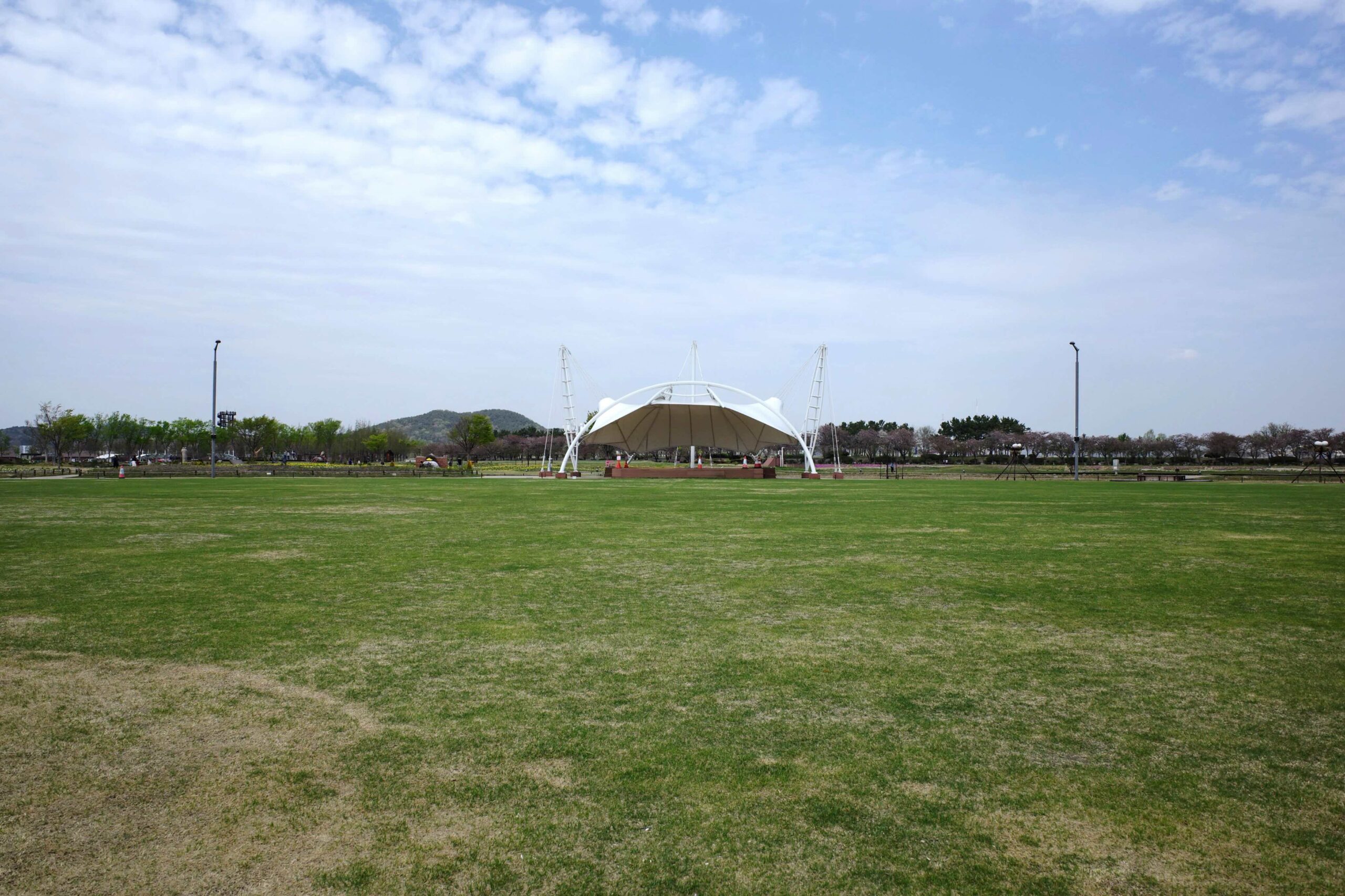
Standing at the top, the full logic of the park finally becomes legible: the evaporation grids to one side, the wooden activity buildings clustered like a small village, the lawn rolling toward the white tensile shell of the outdoor stage, the walking paths threading through grass and reed in every direction. It is, in the end, a reclaimed industrial site that never fully shed its original skin — and all the more worth seeing for it.
Practical Details
Siheung Gaetgol Eco Park (시흥갯골생태공원) 287 Dongseo-ro, Jangok-dong, Siheung-si, Gyeonggi-do
- Open year-round, 24 hours. Free admission. Free parking.
- Paid experiences (water bikes, multi-person bikes, salt farm): seasonal, Tue–Sun; rates from ₩14,000/30 min.
- Check the official site before visiting as activity schedules vary by season and weather.
- Official site: www.shsi.or.kr
The salt is long gone. What remains is stranger and better.